iFixAdBlue — Leicester & the Midlands
Motorhome AdBlue Problems: Why Storage and Low Mileage Cause Faults
Most AdBlue guides are written for vans doing 20,000 miles a year. If your motorhome does 5,000 and sits from October to March, the failure modes are completely different.
Motorhome AdBlue problems are most commonly caused by the system sitting unused for months rather than a component failure. When a Ducato-based motorhome is stored over winter, AdBlue degrades in the tank, crystallises around the dosing injector, and the level sensor can stick — producing warning lights as soon as you start the engine in spring. A mobile diagnostic and flush typically resolves this without major parts.
Every spring, we see a wave of motorhome owners across Leicester, Loughborough, and the surrounding Midlands dealing with the same problem: the vehicle has been stored since October, they’ve brought it out for the season, and within a few miles an AdBlue warning has appeared. Sometimes it’s a simple level alert. Sometimes it’s a fault code that puts the van into a countdown. Sometimes, on a badly neglected system, it won’t start.
The issue isn’t usually a broken component. It’s the way motorhomes actually get used — and the way AdBlue behaves when a vehicle sits still for five or six months.
What’s in this guide
Why motorhomes are harder on AdBlue systems
The vast majority of UK motorhomes built after 2015 are based on the Fiat Ducato platform. The Ducato’s AdBlue and SCR system is a well-engineered piece of kit when it’s used regularly. The problem is that motorhomes aren’t used regularly — by design.
A typical Ducato panel van covering a trade route might do 25,000 miles a year. The AdBlue gets topped up frequently, the system is always warm, and the dosing injector never gets a chance to crystallise because it’s spraying constantly. A motorhome might do 4,000 to 6,000 miles annually, and a good chunk of those miles happen in a five-month touring window from April to September. From October to March, the system sits completely cold and unused.
That duty cycle creates failure conditions that van-oriented AdBlue guides simply don’t cover. The guidance you’ll find on most forums — “top it up and it’ll be fine” — is written for vans, not motorhomes. For a stored vehicle, the picture is significantly different.
AdBlue is a 32.5% urea solution that reduces nitrogen oxide (NOx) emissions by up to 90% when injected into the exhaust stream. It’s effective fluid, but it has a shelf life. According to ISO 22241, opened AdBlue typically has a shelf life of around 12 months and begins to degrade if stored above 30°C or repeatedly frozen and thawed — conditions motorhome storage can easily create. (Source: Tanks-UK AdBlue guide)
What happens to AdBlue during winter storage
Over a winter lay-up, several things happen to an AdBlue system that don’t happen when a van is running regularly.
The fluid degrades in the tank
AdBlue that’s been sitting in a tank since September has likely been through several freeze-thaw cycles by March, depending on where the motorhome is stored. While a single freeze at −11°C doesn’t chemically damage AdBlue, repeated freeze-thaw cycling stresses the tank mounting and any plastic components around it. More importantly, the urea concentration can shift slightly during storage, which the SCR system’s quality sensor will detect and flag as a “low concentration” fault code — even if the tank is full of what you’d consider perfectly normal fluid.
The dosing injector crystallises
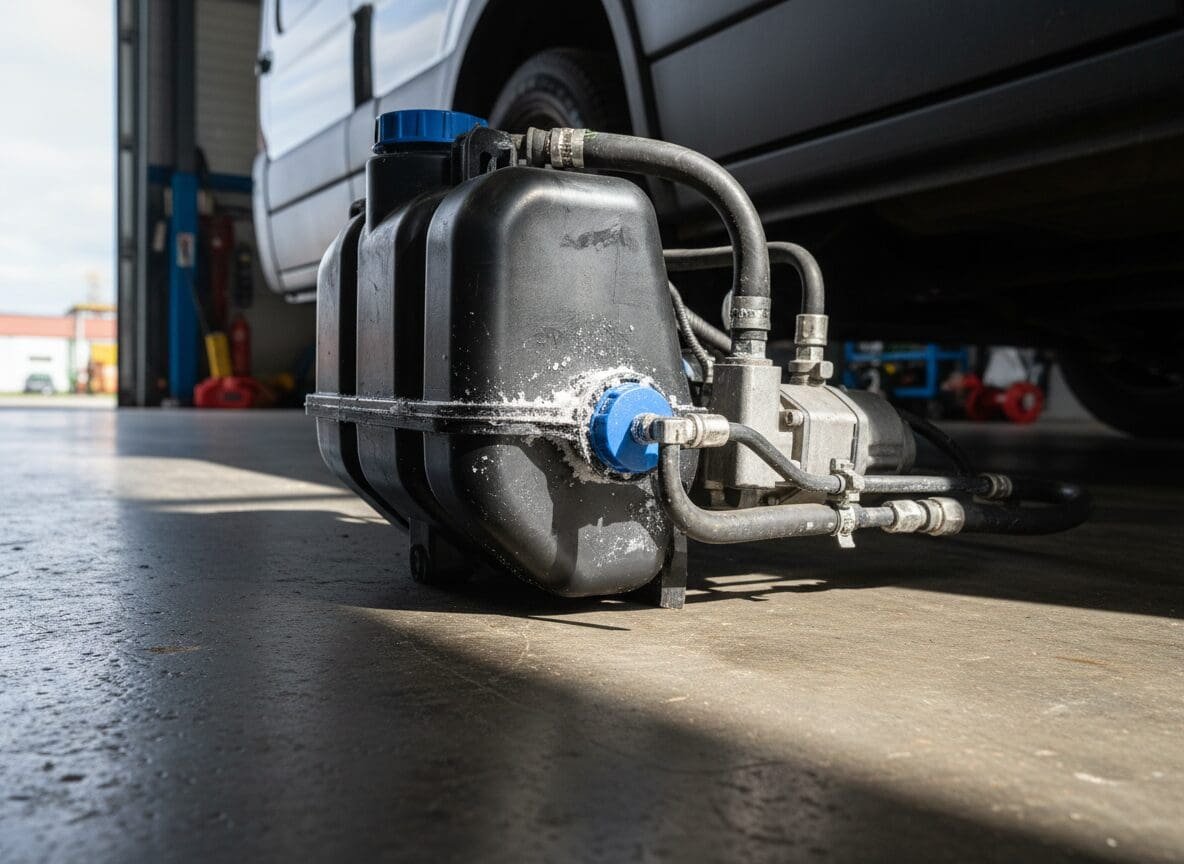
The AdBlue dosing injector is designed to handle a brief purge cycle every time you switch off the engine, drawing the remaining fluid back up the return line to prevent crystals forming at the tip. That purge relies on the system being used regularly. After five months of no activity, residual fluid in the injector tip evaporates and the urea crystallises into a hard white deposit. This doesn’t always block the injector completely, but it causes inconsistent spray patterns — which the NOx sensor downstream picks up as poor SCR efficiency, triggering fault codes.
The level sensor sticks
The AdBlue level sensor is a float mechanism inside the tank. On Ducato-based motorhomes, these sensors are known to stick after a period of inactivity, producing a falsely low reading. The result is a low-AdBlue warning appearing on the dash even if the tank was full when you stored the vehicle. Topping up doesn’t resolve it — the sensor physically needs to be freed, or in persistent cases, replaced.
If your motorhome shows a no-start countdown (e.g. “AdBlue: start in X journeys”) after winter storage, don’t just top up and hope the counter resets. The countdown is stored in the ECU and requires a diagnostic reset with the correct scan tool — adding more fluid won’t clear it. See our guide to Fiat Ducato AdBlue reset procedures for the full detail.
The filler-cap vent problem motorhome guides miss
This one is specific to motorhomes and rarely appears in generic AdBlue articles. The AdBlue filler cap on the Ducato has a small vent hole that allows pressure equalisation as the tank expands and contracts with temperature changes. When a motorhome sits through an entire winter, this vent hole has been found to dry out and crack on older caps, or in some cases to become blocked with crystallised AdBlue residue from the cap’s own internal o-ring.
A blocked vent creates a slight vacuum in the tank as fluid is used, which can eventually collapse the tank walls — a known failure mode reported by Ducato owners on motorhome forums. This isn’t a cheap fix. Tank replacement on a Fiat Ducato typically runs to £400–£900 for parts and labour.
The straightforward preventive step is to inspect the filler cap closely at the start and end of each season, looking for cracks or white crystalline residue around the vent. If the cap looks dry or the vent is blocked, replace the cap before it causes a tank failure — a cap costs a fraction of a tank replacement.
We cover Ducato-specific faults including tank and injector issues in far more depth in our complete Fiat Ducato AdBlue problems guide.
Reading the warning lights after storage
When a stored motorhome produces AdBlue warnings, it helps to understand what each message is actually telling you before deciding whether to top up, reset, or call for a diagnostic.
| Warning message | Most likely cause | Immediate action |
|---|---|---|
| AdBlue low / Add AdBlue | Genuine low level or stuck level sensor | Top up; if warning persists after filling, suspect sensor |
| AdBlue fault / SCR system fault | Degraded fluid, injector crystallisation, or sensor fault | Book diagnostic — topping up won’t resolve this |
| Start in X journeys | No-start countdown triggered by previous fault | Requires diagnostic reset; see note above |
| Emissions system malfunction | NOx sensor reading poor SCR efficiency | Diagnostic required to identify root cause |
The key distinction is between a level warning (which topping up will usually fix if the sensor is working correctly) and a fault or system warning (which indicates a component or fluid quality issue that a top-up won’t resolve).
The four most common motorhome AdBlue faults
Based on the jobs we see each spring, these are the faults that come up most often on stored Ducato-based motorhomes.
1. Low concentration / quality fault (P207F, P20A0)
The SCR system tests the quality of the AdBlue it’s injecting against a reference value. Fluid that has been sitting for six months and gone through repeated freeze-thaw cycles can drift outside the acceptable range, triggering a quality fault. The fix is to drain the tank, flush the system, and refill with fresh certified fluid — then a diagnostic reset to clear the stored code. Don’t attempt to “dilute” old fluid with fresh AdBlue; the tank needs to be emptied properly.
2. Dosing injector fault (P0428, P20EE)
Crystallisation in or around the dosing injector is common on vehicles stored over winter. Minor crystallisation may clear after a few warm-up cycles, but significant build-up requires the injector to be removed and cleaned, or in worse cases replaced. We cover the symptoms in detail on our AdBlue crystallisation guide.
3. Level sensor fault (false low reading)
As described above, sticky level sensors after storage are a known Ducato behaviour. If the tank reads “low” immediately after you’ve confirmed it’s full, the sensor module — typically integrated with the pump in a combined unit — is the suspect. Replacement involves accessing the top of the tank, usually via a floor or chassis panel in the motorhome.
4. Degraded fluid triggering NOx sensor alert
Even if the injector and sensor are working perfectly, the system’s downstream NOx sensor will flag an issue if the SCR catalyst isn’t reducing emissions efficiently — and degraded AdBlue reduces efficiency. This can look like an expensive fault but often resolves completely once the old fluid is replaced and the system is reset. It’s worth ruling out fluid quality before replacing catalytic components.
What to do before your first trip of the season
If your motorhome has been stored over winter and you’re preparing for the new season, here’s a practical sequence before you load up for the first trip.
Start by checking the AdBlue level using the dash readout or filler neck dipstick, and top up with fresh ISO 22241-certified fluid if you’re under three-quarters. Don’t overfill — the vent system in the cap needs room to work. Next, inspect the filler cap visually for cracks or white deposits, and the cap vent hole for blockages.
Then start the engine and let it run for 15–20 minutes in a ventilated space, watching for any AdBlue warnings on the dash. If no warnings appear and the exhaust smells clean, the system has likely purged cleanly through the first warm-up cycle.
If a warning does appear — especially anything beyond a simple low-level alert — the right move is a diagnostic before you put 200 miles between yourself and your base. A mobile diagnostic visit can read the exact fault codes, test the injector spray pattern, and check the fluid quality sensor reading, giving you a clear picture of whether it’s a quick fix or something that needs parts. We cover AdBlue storage and shelf life in more depth in our guide to how long AdBlue lasts — including what stored fluid looks like when it has and hasn’t degraded.
We cover motorhomes as well as vans — including those on private driveways and storage sites across Leicester, Loughborough, and the surrounding Midlands. If your motorhome throws an AdBlue fault ahead of the season, we can come to you. Call 07349 821 999 or check the AdBlue warning still on after refill guide if the light’s on after topping up.
Frequently asked questions
Does AdBlue go off if my motorhome is stored for winter?
Yes. AdBlue has a typical shelf life of around 12 months once opened, and the conditions inside a stored motorhome — particularly if it freezes overnight — can accelerate degradation. The urea concentration can drift slightly outside specification, which the vehicle’s SCR quality sensor will detect. If your motorhome has been stored for more than a season without use, it’s worth draining and replacing the fluid rather than topping up old stock with fresh.
Why does my motorhome AdBlue warning come on in spring after winter storage?
The most common causes are a stuck level sensor (giving a falsely low reading despite a full tank), crystallised residue in the dosing injector (triggering an SCR efficiency fault), or degraded fluid quality flagged by the concentration sensor. In some cases, a countdown from a previous fault stored in the ECU triggers immediately on startup. A proper diagnostic will identify which of these applies rather than making you guess.
Can low mileage cause AdBlue system faults on a motorhome?
Yes, indirectly. The AdBlue dosing injector is designed to purge itself after each drive cycle, but if mileage is very low, that purge cycle doesn’t happen frequently enough to prevent crystallisation in the injector tip. Similarly, very short trips don’t allow the SCR system to reach optimal operating temperature, which reduces its efficiency and can cause the NOx sensor to log fault codes over time. Longer runs — 45 minutes or more at a sustained speed — keep the system in better condition than many short trips.
How often should I top up AdBlue in a motorhome?
AdBlue consumption is roughly 4–6% of diesel consumption — around 5 litres of AdBlue for every 100 litres of diesel. At typical motorhome fuel efficiency, that works out to roughly 1 litre of AdBlue per 600–800 miles. On a 5,000-mile year, you’d expect to top up perhaps twice. The key for motorhomes is to top up before storage with fresh certified fluid, and to check the level again before your first trip of the new season rather than assuming the tank is still full.
AdBlue fault before your season starts?
We carry out mobile AdBlue diagnostics across Leicester, Loughborough, Hinckley, Coalville, Market Harborough, and the Midlands — including at private driveways and storage sites.
Mon–Sun 09:00–20:00 • No dealership required
Written by
iFixAdBlue Technical Team — AdBlue, SCR, EGR and emissions specialists serving Leicestershire and the East Midlands. Published . Updated .