AdBlue Fluid Quality Guide
AdBlue Pump vs Container: Which Is Safer for Your Van’s SCR System?
The AdBlue pump vs container question gets answered as a price comparison almost everywhere online. That is the wrong axis. The fluid is identical either way — what differs is how much opportunity each method gives dirt, dust and the previous user to get into your tank.
What This Guide Covers
- The fluid is the same — the dispensing is not
- AdBlue pump vs container, side by side
- Why the truck pump is the one to be careful with
- What actually contaminates AdBlue on the way in
- Crystals round the filler neck: handling, not fault
- The part-used container problem
- What we would actually do
- Frequently asked questions
The fluid is the same — the dispensing is not
Start with the thing that settles most of the argument. AdBlue is not a brand of fluid with better and worse versions. It is a defined mixture of high-purity urea and deionised water made to the ISO 22241 specification, and the name itself is a trademark licensed against that specification rather than a recipe someone owns.
So a forecourt pump and a sealed jug from the same forecourt shop are, at the point of manufacture, carrying the same thing. Anyone telling you pump AdBlue is a lower grade of fluid is guessing.
What the specification cannot do is follow the fluid all the way into your tank. Quality is set at the plant and then either preserved or lost in transport, storage and dispensing. That is where the two methods genuinely differ, and it is the only part of this comparison worth thinking about.
AdBlue pump vs container, side by side
| Forecourt / truck pump | Sealed container | |
|---|---|---|
| Fluid specification | Same — ISO 22241 | Same — ISO 22241 |
| Cost per litre | Usually lower | Usually higher |
| Shared nozzle | Yes — used by every vehicle before you | No |
| Suits a light-vehicle filler | Often not, on truck-lane pumps | Yes, designed for it |
| Overfill and spill risk | Higher — high flow rate | Lower — controlled pour spout |
| Leftover fluid to store | None | Often, and storage is then your problem |
| Best suited to | Trucks, and cars only at dedicated light-vehicle pumps | Cars, vans, pickups, motorhomes |
Read that table and the pattern is clear. The pump wins on cost and on not leaving you with a half-used jug. The container wins on everything to do with keeping the fluid clean and getting it into the right hole at a sensible rate.

Why the truck pump is the one to be careful with
This is the part that gets left out of the price comparisons. Not every forecourt AdBlue pump is intended for your vehicle, and the producers say so directly. TotalEnergies’ own guidance is to always ask whether the pumps are designed to refill the tank of a passenger car, because it is likely only heavy-duty trucks can refill at the pump — the station equipment is specified for truck use, particularly the flow speed, which is matched to a tank many times the size of yours.
Three practical consequences follow from that.
The nozzle may not fit, or may not seat properly
Truck-lane nozzles are larger and frequently magnetic or latch-actuated, designed to lock into a commercial filler. Held loosely against a car or van filler neck they do not seal, and what does not go in the tank goes down the paintwork.
The flow rate is wrong for the tank
A truck pump is built to move a lot of fluid quickly. A van AdBlue tank holds a small fraction of that, and the filler neck has a narrow vent path. Fast fill plus poor venting equals blowback, which is the most common cause of AdBlue ending up outside the tank rather than in it.
The nozzle is shared, and nothing cleans it
Truck-lane equipment lives outdoors and is handled by hundreds of drivers. Grit, road dust and whatever was on the last pair of gloves sit on the nozzle tip, and none of it is filtered out on the way in. On its own it is unlikely to fail a system. Repeated, it is a slow contamination source.
Where a station has a dedicated light-vehicle AdBlue pump, none of that applies and it is a perfectly sensible way to fill. The distinction is between pumps built for your vehicle and pumps built for an artic.
What actually contaminates AdBlue on the way in
Having attended a fair number of fluid-quality faults, the causes are boringly consistent and none of them are the manufacturer’s fault.
- A shared funnel. Easily the biggest one. A funnel that has had engine oil, diesel or coolant through it will pass a trace of that into the tank every single time it is used.
- A dirty filler neck. Road dust and grit sit in the recess around the cap. Whipping the cap off and pouring straight away washes that debris in.
- Rainwater. Filling in the wet with the cap off and the jug tilted lets water in, which shifts the urea concentration off specification without adding anything visible.
- The wrong container entirely. A jug previously used for screenwash leaves detergent and dye behind — both are chemical impurities the SCR catalyst has no tolerance for.
All four are handling problems with handling fixes: a dedicated AdBlue-only funnel or a sealed pour-spout container, a wipe round the filler recess before the cap comes off, and not filling in the rain if you can avoid it.
What they produce, though, looks nothing like a handling problem on the dashboard. Off-specification fluid presents as a quality or SCR performance warning, which is exactly what a failing sensor or injector also presents as. Telling those apart needs live dosing data, which is the point of a proper mobile diagnostic session rather than a code read.
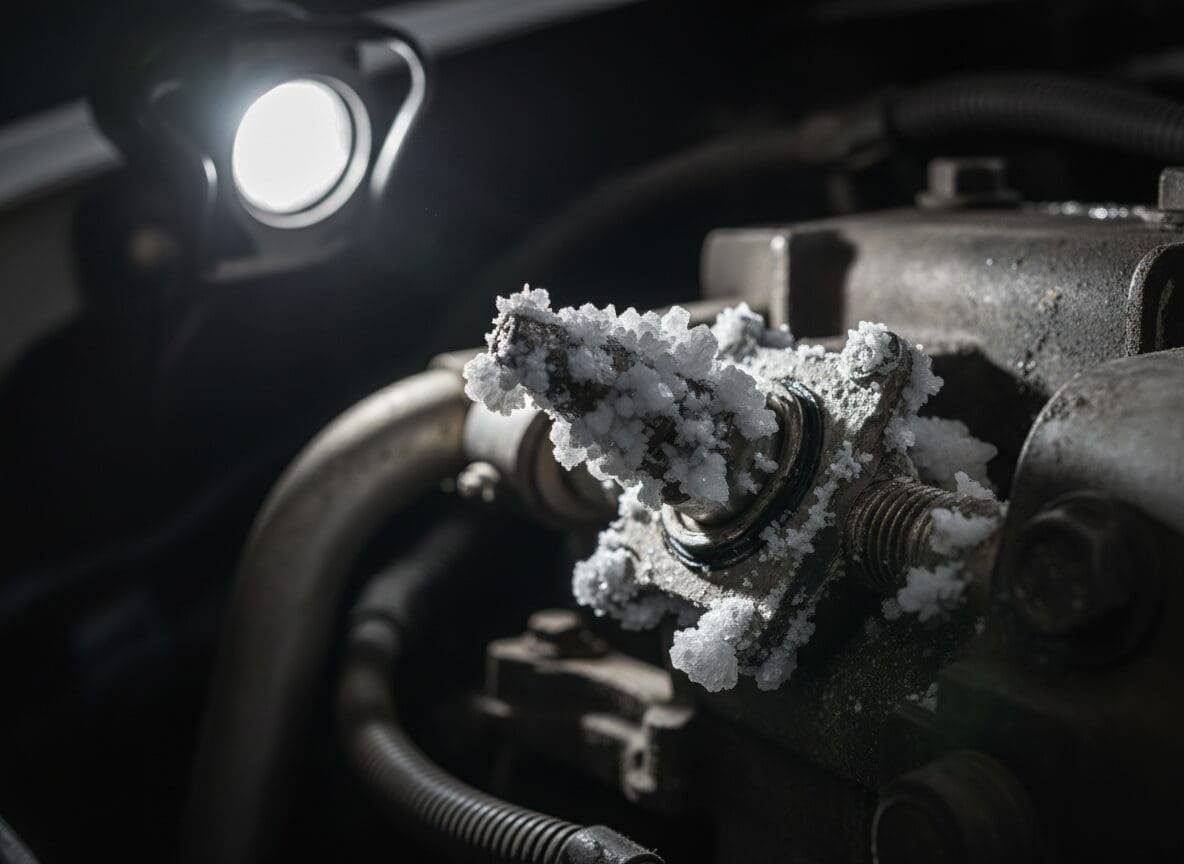
Crystals round the filler neck: handling, not fault
A white or pale-yellow crust around the AdBlue filler cap is one of the most common things we get asked about, and it is usually the least worrying thing on the vehicle.
AdBlue crystallises when it is exposed to air and the water evaporates, leaving urea behind. Spill a little down the neck while filling, leave it, and you get a crust. It is cosmetic, it rinses off with warm water, and it tells you something about your filling technique rather than about the SCR system.
What it is not is the same phenomenon as crystallisation inside the dosing system, which happens at high temperature in the exhaust and does cause real damage to the injector and catalyst. The two share a name and almost nothing else, and conflating them is why people panic about a crust and ignore the deposits that matter. We have set out the difference and the actual damage mechanism in our guide to AdBlue crystallisation.
The part-used container problem
The container option has one genuine drawback, and it is the reason some drivers prefer the pump: a 10-litre jug rarely goes into a car or van tank in one go, so you end up storing the rest.
An opened container is a different item from a sealed one. The seal is what protects the fluid, and once it is off, the clock on that fluid is running and its condition depends entirely on where you keep it. A part-used jug rolling around a hot van load space with a loose cap is a genuinely plausible contamination source.
Two practical rules cover it. Buy the pack size you will actually use — for most cars and vans that is a 5-litre or a pair of 1.89-litre bottles, not a 10-litre drum. And if you do have a part-used container, keep the cap tight, keep it out of direct sunlight and use it up rather than treating it as a permanent fixture in the van.
How long that fluid stays usable, and what heat and light actually do to it, is a separate question with a proper answer — we cover it in our guide to AdBlue shelf life and storage.
What we would actually do
For a car, van, pickup or motorhome: sealed containers, in a size you will finish, with a dedicated AdBlue-only pour spout. It costs a little more per litre and removes every dispensing variable in one move.
Use a forecourt pump where the station has a light-vehicle AdBlue pump specifically. Skip the truck lane unless you drive a truck — not because the fluid is worse, but because the equipment is not built for your filler and the odds of a messy, part-in, part-down-the-side fill are high.
And treat a fluid-quality warning that appears shortly after a fill as a real fault rather than something the next tankful will clear. It sometimes does clear, but a system that has been fed off-specification fluid can hold a stored fault and keep under-dosing. If a warning has appeared after a top-up and stayed, that is a diagnostic job — our AdBlue fault resolution service covers exactly this, and there is more on the specific after-filling scenario in our guide to an AdBlue warning light that stays on after filling.
AdBlue Warning After a Fill? We Come to You
Mobile AdBlue and SCR diagnostics with live dosing data across Leicester, Loughborough, Hinckley, Coalville, Melton Mowbray, Market Harborough and the wider East Midlands.
Frequently Asked Questions
Is AdBlue from the pump the same as bottled AdBlue?
Yes. Both are made to the same ISO 22241 specification — 32.5% high-purity urea in deionised water — so there is no quality difference at the point of manufacture. The difference is in dispensing: pump fluid passes through a nozzle shared by every vehicle before you, while a sealed container has touched nothing. Neither is a lower grade of AdBlue.
Can I use an HGV AdBlue pump to fill my van?
Often not, and it is worth asking before you try. Truck-lane pumps are specified for heavy-duty vehicles, particularly the flow speed, which is matched to tanks many times larger than a van’s. The nozzle may not seat in a light-vehicle filler neck and the fast fill causes blowback. Where a station has a dedicated light-vehicle AdBlue pump, that is fine to use.
Do I need a funnel to put AdBlue in?
Only if your container has no pour spout, and if you do use one it must be dedicated to AdBlue and nothing else. A funnel that has previously had engine oil, diesel, coolant or screenwash through it will introduce a trace of that into the tank every time. A shared funnel is the single most common contamination route we come across on working vehicles.
Why is there white crust around my AdBlue filler cap?
That is spilled AdBlue that has dried out — the water evaporates and leaves the urea behind as crystals. It is cosmetic and rinses off with warm water and a cloth. It is not the same as crystallisation inside the dosing system, which forms at exhaust temperature and does cause real damage. A crust at the cap tells you about your filling technique, not about the SCR system.