AdBlue Contamination Guide
Diesel in the AdBlue Tank: What Happens Next and How It Gets Fixed
Diesel in the AdBlue tank is not the same problem as AdBlue in the diesel tank, and it is not fixed the same way. The single decision that changes the repair bill is made in the first few minutes, before the engine is ever started.
What This Guide Covers
- The first ten minutes decide the bill
- Why diesel is so destructive to an SCR system
- How bad is it? Three things decide
- What a proper repair actually involves
- Water, screenwash and the other wrong fluids
- How it happens in the first place
- Not to be confused with the other misfuel
- Frequently asked questions
The first ten minutes decide the bill
Almost every expensive version of this job has the same sentence in it: “I only ran it for a couple of minutes to see if the light would go out.” That is the difference between a drain and a flush, and a new dosing pump, injector and catalyst.
The reason is mechanical rather than chemical. While the vehicle is switched off, diesel in the AdBlue tank does very little. It is lighter than the urea solution, so it separates and sits on top as a distinct layer. Nothing is being pumped anywhere.
The moment the ignition is on and the SCR system primes, the dosing pump starts drawing from the tank and pushing whatever it finds through the metering lines and out of the injector into the hot exhaust. That is when contamination stops being a tank problem and becomes a whole-system problem.
Why diesel is so destructive to an SCR system
AdBlue is a deliberately boring fluid. It is 32.5% high-purity urea in 67.5% deionised water, made to the ISO 22241 specification, and the entire SCR system is engineered around exactly that. The pump seals, the metering tolerances, the injector orifice and the catalyst coating all assume a clean, water-based solution and nothing else.
Diesel breaks that assumption in three separate ways at once.
It is an oil, and the system has no way to handle oil
The dosing pump is a low-pressure unit designed to move a thin aqueous fluid. Diesel is viscous by comparison and leaves a film on every internal surface it passes. Seals and diaphragms specified for urea solution swell and distort in contact with hydrocarbons.
It blocks the injector, and the injector is the tightest part of the circuit
The dosing injector atomises AdBlue into a fine mist so it can react across the catalyst. Its orifice is tiny by design. An oily residue baking onto it in a hot exhaust does not wash out on the next tankful — it carbonises and blocks.
It can poison the catalyst, and the catalyst is the expensive part
The SCR catalyst works because of a precious-metal and washcoat surface with a very large active area. Anything that coats that surface takes it out of service permanently. There is no cleaning process that restores a fuel-contaminated SCR brick, which is why the priority is always to stop the mixture reaching it.
That is also the honest answer to the question people really want answered: the tank is rarely the expensive part. Tank work is a known quantity, and if you want the shape of those figures we cover it separately in our guide to AdBlue tank replacement. Everything downstream of the tank is what you are protecting by not starting the engine.
How bad is diesel in the AdBlue tank? Three things decide
When we take this call, there are only three questions that change the answer. Everything else is detail.
| Factor | Best case | Worst case |
|---|---|---|
| Was the engine started? | Never turned on — contamination is still in the tank only | Driven until the warning appeared — pump, lines, injector and catalyst all exposed |
| How much went in? | A splash into a nearly full tank of AdBlue | A jerry can emptied into a low tank, so the mixture is mostly fuel |
| How long has it sat? | Caught immediately, drained the same day | Left a week, seals already swollen and residue settled |
Note what is not on that list: the make of the vehicle. Diesel contamination behaves the same way in a Sprinter, a Transit and a Ducato, because they all use the same fundamental dosing architecture. That is unusual in AdBlue work, where most faults are genuinely model-specific.
What a proper repair actually involves
The sequence matters more than the parts list. In order: the tank is emptied of the mixture, the tank interior is cleaned rather than just rinsed, the dosing lines are cleared, and only then is the system refilled and run.
Running the system before that sequence is complete is how a contained problem becomes a parts bill. This is also why the roadside “just dilute it with fresh AdBlue” advice is wrong — you cannot dilute an oil into a water-based solution, you just have a larger volume of contaminated fluid.
After the flush, the system needs watching rather than signing off. Contamination frequently leaves a dosing-quality or system-performance fault stored even once the fluid is clean, and a stored fault with a clean tank looks exactly like a sensor failure to a basic code reader. A proper mobile diagnostic session reads live dosing quantity and pressure rather than just pulling codes, which is the only way to tell a recovered system from one that is still under-delivering.
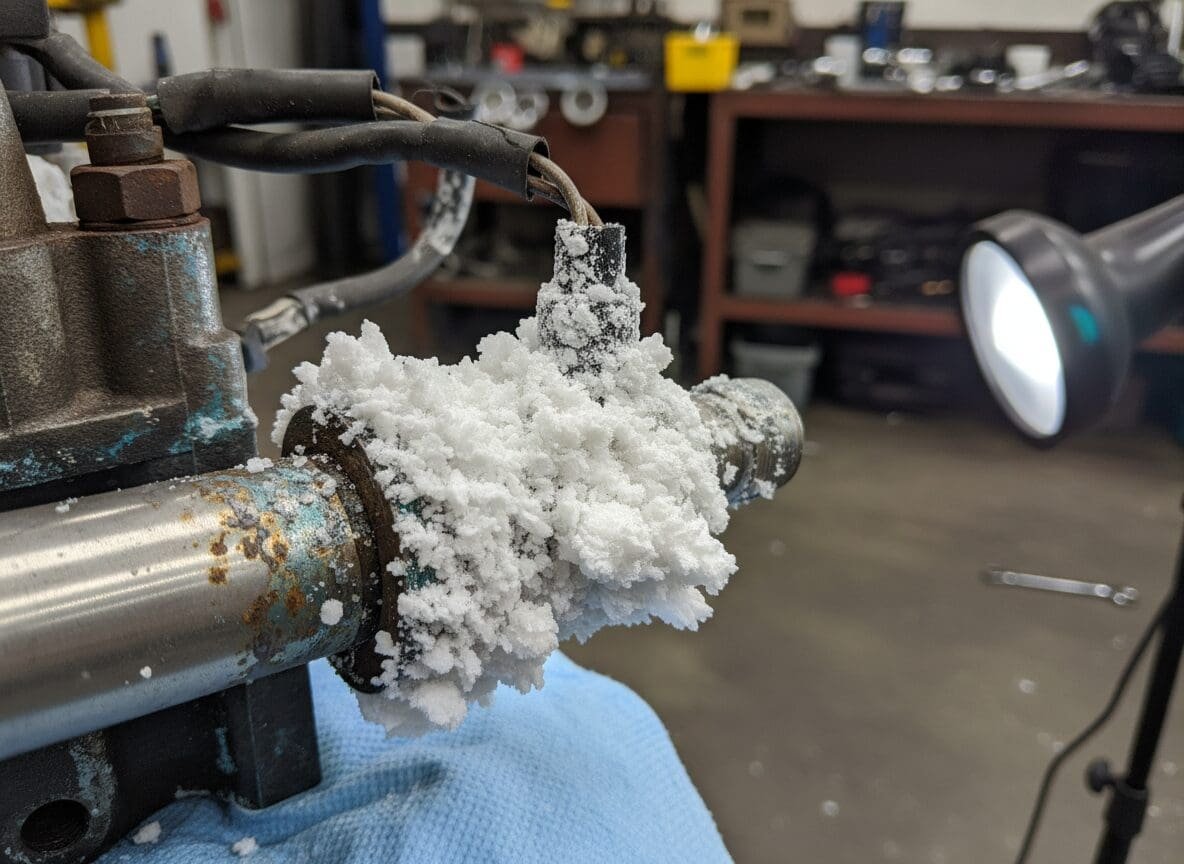
If the injector was run while contaminated, expect crystalline deposits as well as carbon. The two failure modes overlap and are often treated as one problem when they are not — there is more on how deposits form and what they damage in our guide to AdBlue crystallisation.
Water, screenwash and the other wrong fluids
Diesel is the one that gets talked about, but it is not the most common wrong fluid we see going into an AdBlue filler. Tap water and screenwash are both more frequent, usually poured in deliberately by someone who had been told AdBlue is “basically water”.
Water is the most misunderstood of the three because it does no immediate mechanical harm. What it does is move the urea concentration away from specification, and the quality sensor is watching precisely that. The fluid producer’s own guidance is blunt on this point: where water has gone in instead of AdBlue, do not start the engine and contact a professional. Same instruction, same reason.
Screenwash is worse than plain water, because it adds detergents, dyes and alcohols to the mix. Those are exactly the chemical impurities the SCR catalyst has no tolerance for. Petrol behaves broadly like diesel but is more aggressive to seals.
All four end up in the same place diagnostically: a fluid-quality fault. If you want to see what the system reports when it decides the solution is off-specification, that is covered in our P207F reductant quality guide.
How it happens in the first place
This is almost never carelessness. It is nearly always one of four specific situations, and knowing them is the whole of the prevention.
- Two filler necks under one flap. On a lot of vans the AdBlue filler sits directly beside the diesel filler. In poor light, with a nozzle in hand, the blue cap is not as obvious as manufacturers assume.
- An unlabelled container in the back. A jerry can of diesel and a jug of AdBlue look identical from above once the labels have worn off. This is the single most common cause on working vehicles.
- Someone else filling it. A colleague, a valeter, a hire driver or a forecourt attendant doing a favour. They did not know the vehicle had a second filler.
- A shared funnel. A funnel that last had diesel or oil through it introduces a small amount of contamination every time. It rarely triggers a fault on its own, but it steadily degrades fluid quality.
The fixes are equally mundane: label the AdBlue container, keep a dedicated AdBlue-only funnel or use a sealed pour-spout container instead, and never store a fuel can and an AdBlue jug side by side in the same load space.
Not to be confused with the other misfuel
Putting AdBlue into the diesel tank is a completely different incident with a different urgency, a different repair and a different set of risks to the engine. It is a fuel-system job rather than an emissions-system job. The two are regularly confused in forum threads and in the advice people are given over the phone, so it is worth being precise about which one you are dealing with before anyone starts draining anything.
The test is simple. Which cap did the nozzle go into? If it was the blue one, you have the problem this guide describes, and the SCR system is what is at risk. If it was the black or green one, you have a fuel-system contamination event and the engine is what is at risk.
Either way, the instruction for the next ten minutes is identical, which is probably why they get muddled: do not start it.
What we would actually recommend
Most guides on this topic end by telling you to call a main dealer. We would not, and not for the obvious reason. A dealer will resolve it correctly, but the job is a drain, a clean and a live-data verification, and it does not need the vehicle recovered to a workshop to happen. Recovery is frequently the largest single line on the invoice for a fault that never required the vehicle to move.
What it does need is somebody who will verify the system after the flush rather than clearing the code and handing the keys back. That verification is the whole job. If you are dealing with a contaminated AdBlue tank in Leicestershire or the wider East Midlands, our AdBlue fault resolution service comes to the vehicle rather than the other way round.
Contaminated AdBlue Tank? Don’t Start It
Mobile AdBlue drain, flush and live-data verification across Leicester, Loughborough, Hinckley, Coalville, Melton Mowbray, Market Harborough and the surrounding East Midlands.
Frequently Asked Questions
What happens if you put diesel in the AdBlue tank?
Diesel separates and floats on the urea solution, so while the vehicle is switched off the contamination stays in the tank. Once the engine runs, the dosing pump draws the mixture through the metering lines and injector into the hot exhaust, leaving an oily film on seals, blocking the injector orifice and risking permanent contamination of the SCR catalyst. The damage comes from circulating the mixture, not from it sitting in the tank.
Can you drive with diesel in the AdBlue tank?
No. Driving is the single worst thing you can do, because it pumps the contaminated mixture through the entire dosing circuit and into the catalyst. Even turning the ignition on to check the dashboard can be enough to prime the dosing system on some vehicles. Leave it switched off and have the tank drained before the system is run at all.
Will draining the AdBlue tank fix it on its own?
Only if the engine was never started. If it was, the tank is just the first step — the dosing lines and injector need clearing too, and the system needs live-data verification afterwards to confirm dosing quantity and pressure have returned to normal. Contamination often leaves a stored quality or performance fault that looks like a failed sensor to a basic code reader.
How do I know if my AdBlue is contaminated?
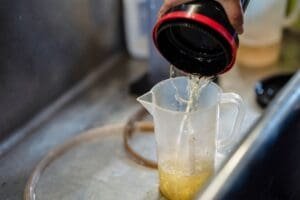
The usual sequence is a fluid-quality or SCR performance warning appearing shortly after a fill, often with a countdown to a no-start condition. Contaminated fluid frequently looks slightly cloudy or shows a separated layer if you can see into the tank. The reliable check is a diagnostic session reading the quality sensor and live dosing values, because the same warnings are also produced by injector and pump faults with perfectly good fluid in the tank.