AdBlue Guide • Wrong-Tank Contamination
AdBlue in the Diesel Tank: What to Do First and What It Costs to Fix
The European car makers’ own advice runs to a single sentence: do not start the engine, and ask a garage for help. Everything that determines whether this costs you a few hundred pounds or a few thousand happens in the next ten minutes.
In This Guide
If you have put AdBlue in your diesel tank, do not start the engine and do not add more diesel to dilute it. Have the vehicle recovered and the tank drained and flushed before it runs. Drained early, this is a fuel-system job costing roughly £250–£600. Started and driven, it becomes an injector and fuel pump job that can run into four figures.
Why AdBlue and Diesel Do Not Mix
AdBlue is not a fuel additive. It is a 32.5% solution of urea in demineralised water, held in its own separate tank and injected into the exhaust, not the engine. The European Automobile Manufacturers’ Association puts it plainly in its own driver guidance: if you put AdBlue in your fuel tank by mistake, do not start the engine but ask a garage for help.
The reason that advice is so blunt is chemistry rather than caution. AdBlue does not burn. It is also water-based and mildly alkaline, and TotalEnergies notes that the fluid is corrosive to some metals, so the components that transport fuel will be degraded once it starts circulating.
Modern common-rail diesel injection makes that worse. The high-pressure pump relies on diesel for lubrication. Urea solution provides none, so the pump can be damaged within seconds of running dry-lubricated, and it sheds metal debris downstream into injectors and lines as it goes.
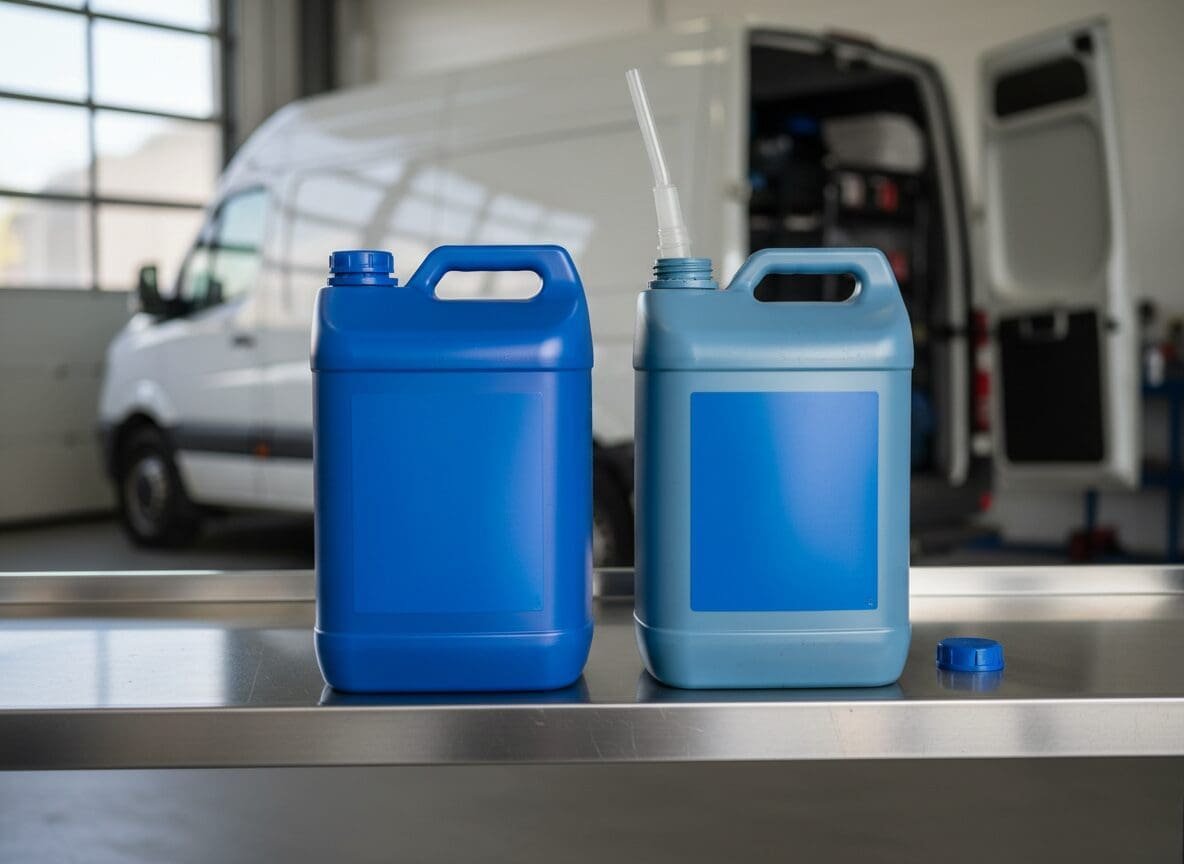
Nearly every expensive version of this fault starts the same way: the driver turns the key “just to see”. Priming the fuel system pulls contaminated fluid out of the tank and into the pump, injectors and rails. A tank you have not started is a drain. A tank you have started is a fuel system.
What to Do in the First Ten Minutes
1. Leave the key alone
Do not start the engine, do not turn the ignition to position two, and do not use remote or timed pre-heating. On many vehicles the low-pressure lift pump primes as soon as the ignition is live, which is enough to move fluid out of the tank.
2. Do not try to dilute it
Adding diesel on top is the most common instinct and the worst one. AdBlue is denser than diesel and does not dissolve into it, so topping up does not thin the contamination out. It simply gives the recovery technician a larger volume of contaminated fluid to remove, and it costs you more, not less.
3. Work out roughly how much went in
A splash from a 1.5-litre top-up bottle into a mostly full tank is a different problem from five litres into a near-empty one, and it changes how a technician approaches the drain. If you still have the container, keep it. If you filled at a pump, keep the receipt.
4. Call for a fuel drain, not a general breakdown
Ask specifically for mobile fuel drainage and decontamination. It is a defined service, most operators will attend at the forecourt or the roadside, and the vehicle should be moved on a flatbed rather than towed with the drivetrain engaged.
What the Repair Involves and What It Costs
A proper decontamination is not just a siphon. The tank is drained, flushed to remove residue clinging to the walls and the sender unit, the fuel filter is replaced, and the lines are purged before fresh diesel goes in. Skipping the flush is why some vehicles come back a week later with a rough-running fault.
| Scenario | Typical UK cost | What is involved |
|---|---|---|
| Not started, drained at the forecourt | £250–£450 | Drain, flush, filter, fresh fuel |
| Not started, recovered to a workshop | £350–£600 | As above, plus recovery |
| Started but not driven | £600–£1,200 | Above, plus lines and rail purged, pump inspected |
| Driven any distance | £1,500–£4,000+ | High-pressure pump and injectors, full system clean |
Those bands are indicative UK figures for cars and light commercial vehicles, not a quotation. Injector prices vary enormously by engine, and a set of four on a modern van can account for most of the top band on its own.
Often, yes. Many comprehensive policies include misfuelling cover, and some include it as an optional extra rather than as standard. It is worth checking your policy documents before you authorise work, because the drain and the consequential damage are sometimes treated differently.
The Mistake Nobody Writes About: Diesel in the AdBlue Tank
Every guide on this subject covers AdBlue going into the diesel tank. Far fewer cover the reverse, and in our experience the reverse is the one that quietly does more damage, because it does not stop the vehicle immediately and so it gets driven.
Diesel, oil, screenwash or even ordinary tap water in the AdBlue tank contaminates the reductant. The vehicle keeps running, sometimes for days. Then the quality sensor or the SCR efficiency check notices that the exhaust chemistry is wrong, and the dashboard produces a fault that looks nothing like a fuelling mistake.
That is where codes such as P207F, reductant quality below threshold, come from. We have written up what P207F actually means and how contamination triggers it separately, because it is one of the most misdiagnosed codes on the SCR system.
The damage pattern is different too. Diesel and oil attack the seals and the dosing injector, while water dilutes the urea concentration below specification. Both leave deposits behind, and both can push the system into the same crystallisation cycle that follows any AdBlue quality problem — something we cover in detail in our guide to how crystallisation damages the injector and pump.
The same rule applies in reverse: do not run the engine, and do not simply top the tank up with genuine AdBlue in the hope of diluting it. The tank has to be drained. Once contaminated fluid has been dosed into a hot SCR catalyst, you are no longer dealing with a fluid problem.
How to Not Do It Again
The confusion is designed in. On a lot of cars and vans the AdBlue filler sits directly beside the diesel filler, under the same flap, and the two necks are similar enough at arm’s length in the dark.
- Blue cap is AdBlue, black is diesel on most European vehicles, though this is a convention rather than a rule — check yours in daylight once and remember it.
- The AdBlue neck is narrower. A diesel forecourt nozzle physically will not fit into a car’s AdBlue filler, which is why the error almost always goes the other way, from a bottle.
- Top up AdBlue when you are not also refuelling. Most wrong-tank incidents happen when a driver is doing both jobs at once with a bottle in one hand.
- Some vehicles put the AdBlue filler elsewhere entirely — in the boot floor, the spare wheel well, or under the bonnet. If yours is not at the fuel flap, that is normal.
There is a wider list of avoidable AdBlue errors that cost drivers money every year, from wrong-spec fluid to letting the tank run dry, in our roundup of AdBlue mistakes worth avoiding.
What Happens to the SCR System Afterwards
Once the fuel side is sorted, there is often a second job waiting. A vehicle that has been recovered, drained and left standing frequently comes back with stored fault codes, and sometimes with a live AdBlue or emissions warning that has nothing to do with the drain itself.
Some of those clear on their own after a few drive cycles. Others need the codes reading properly to separate a stale historic fault from a live one, which is exactly the sort of ambiguity that leads to parts being replaced unnecessarily. If a warning is still showing once the fuel system is clean, it is worth having the SCR side scanned rather than guessed at — that is the work we do, and you can see how we approach it on our AdBlue problems and warning light service.
To be clear about where the line sits: we are a mobile AdBlue and SCR specialist. We do not drain fuel tanks. Get the fuel side done first by a decontamination service, then bring us the emissions fault that is left over, if there is one.
FAQs
How much does it cost to fix AdBlue in a diesel tank in the UK?
If the engine has not been started, expect roughly £250–£600 for a mobile drain, flush, filter change and fresh fuel, depending on whether the vehicle needs recovering. If it has been started or driven, the figure rises sharply because the high-pressure pump and injectors are then in scope, and bills of £1,500 and upwards are common.
Is a small amount of AdBlue in diesel actually a problem?
Yes. There is no safe percentage. AdBlue does not dissolve into diesel and does not burn, so even a litre in a full tank sits there as a separate contaminant waiting to be drawn through the fuel pump. Volume affects how bad the damage is, not whether damage happens.
Can I just fill the tank with diesel to dilute it?
No. Diluting does not work because the two fluids do not mix, and it makes the job larger and more expensive by increasing the volume that has to be removed and disposed of. It also delays the drain, which is the one thing that genuinely reduces the cost.
What if I have already driven the van?
Stop as soon as it is safe and do not restart it. Damage is cumulative, and every additional mile pushes more contaminated fluid through the pump and injectors. Have it recovered on a flatbed and tell the workshop exactly how far it was driven and how it behaved, because that guides how much of the fuel system needs inspecting.
Will this show up on the vehicle’s fault codes?
Not usually as a misfuelling code, because no vehicle has one. What you tend to see is a cluster of fuel rail pressure and misfire codes if the engine has run, or nothing at all if it has not. That is why the diagnosis relies on you telling the technician what went into which tank rather than on the scan tool.
AdBlue Warning Left Over After a Fuel Drain?
Mobile AdBlue and SCR diagnostics across Leicester, Leicestershire and the Midlands. If the fuel system is clean but the emissions warning is still on, we will read the SCR and NOx data properly and tell you what is actually live.
Related Guides
About This Guide
- Written by the iFix AdBlue technical team — mobile AdBlue and SCR specialists covering Leicester, Leicestershire and the Midlands, with 300+ mobile AdBlue jobs completed since 2020.
Published 29 September 2026 • Last updated 29 September 2026