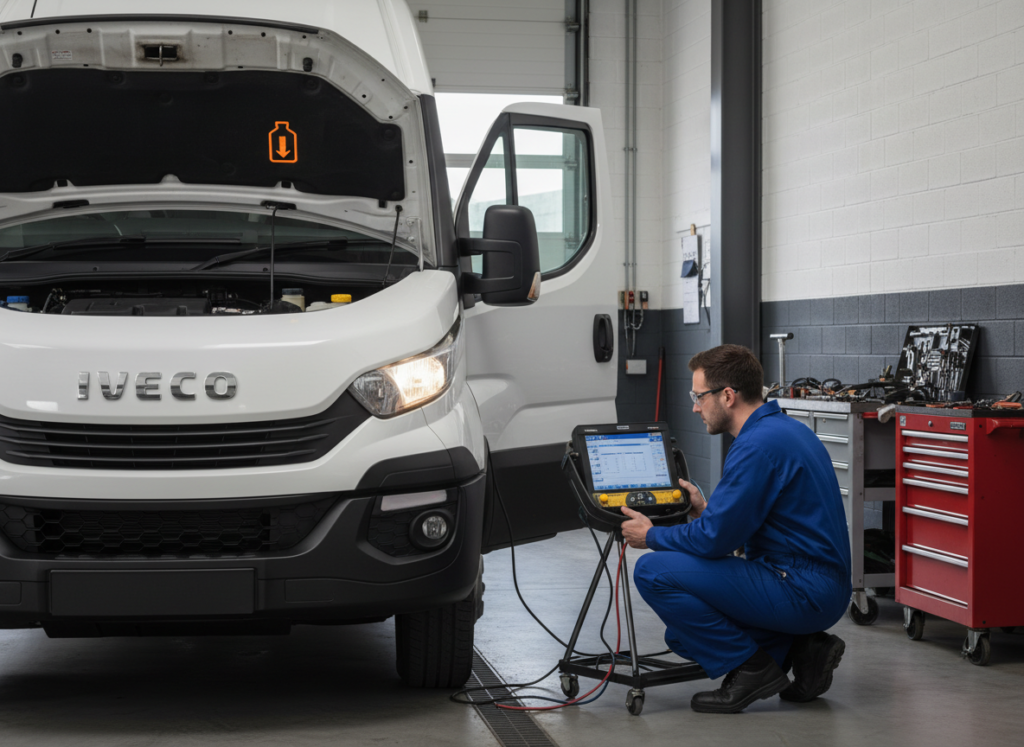
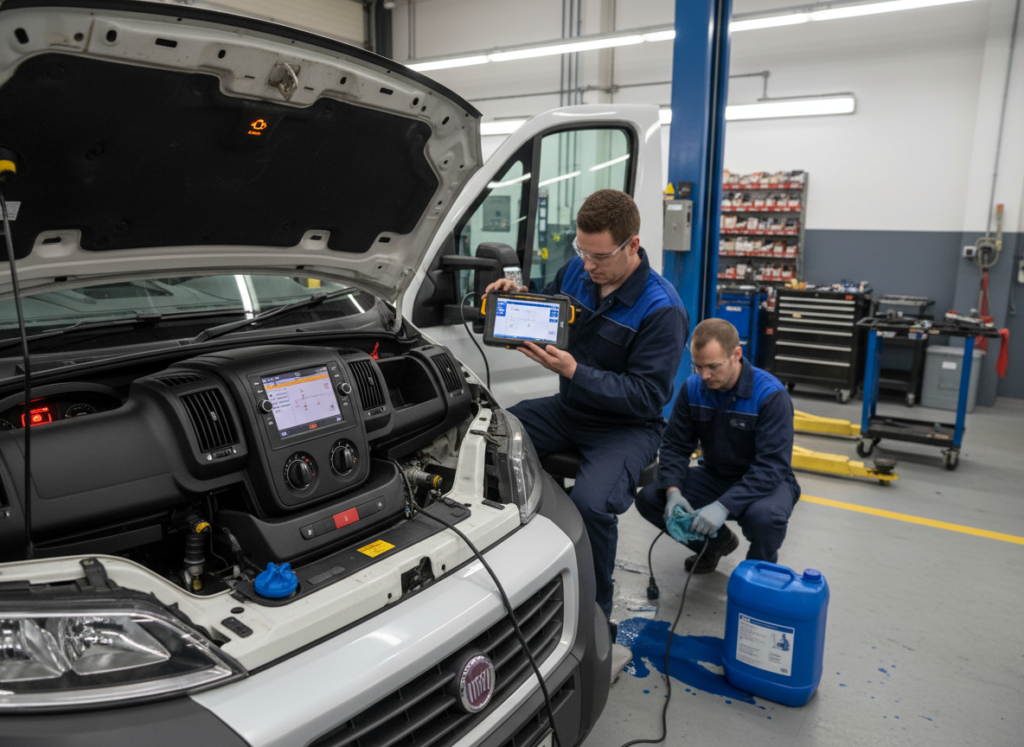
If your Iveco Daily AdBlue light is flashing, it usually means the fault has gone past a simple reminder stage. A steady light can still point to low fluid or an early warning. A flashing warning often feels more urgent because the system is no longer happy with something on the SCR side and wants your attention before the problem gets worse.
:contentReference[oaicite:3]{index=3}
That does not always mean the tank is empty. On the live iFixAdBlue site, repeated warning lights, no-start countdowns, pressure faults, pump faults, NOx-related issues, and SCR performance problems are all described as common reasons an AdBlue warning stays active or gets worse. The service pages also make the point that these faults are often caused by system logic or sensor data rather than one simple broken part. :contentReference[oaicite:4]{index=4}
Contents
Quick answer
A flashing Iveco Daily AdBlue light usually means the SCR system is seeing an active fault, not just a simple reminder to top up. Common causes include poor level recognition, low dosing pressure, injector issues, crystallisation, NOx sensor mismatch, heater faults in colder weather, or an SCR performance issue that is already pushing the van towards a countdown. On the live iFixAdBlue site, these are the same warning patterns tied to AdBlue problems, pump faults, refill faults, winter issues, and no-start messages. :contentReference[oaicite:5]{index=5}
The safest move is to work out whether the van has a genuine low-fluid issue, a fault on the dosing side, or a wider SCR control problem. Guessing can leave you with the same warning, the same countdown, and more money spent than needed. :contentReference[oaicite:6]{index=6}
What a flashing AdBlue light usually means on an Iveco Daily
On a working vehicle, the system wants to see a believable chain. It wants to know there is AdBlue in the tank, that the system can move it, that the injector can dose it, and that the emissions readings on the other side make sense. If any part of that chain drops out, the vehicle may move from a simple warning to a more urgent alert. The live iFixAdBlue no-start guide explains the same logic in plain terms. The countdown is not random. It starts when the ECU decides the emissions system is not doing what it should. :contentReference[oaicite:7]{index=7}
That is why a flashing light matters. It often means the system is not waiting for you to get round to a refill next week. It is telling you there is an active fault state that could move into reduced power, repeated warning messages, or a start-prevention countdown if left alone. The AdBlue warning signs article on iFixAdBlue says the same thing. Leave the warning too long and the dash countdown can drop to zero miles until no start. :contentReference[oaicite:8]{index=8}
Simple version: a flashing warning is usually about system performance, not just fluid quantity.
Common causes behind the warning
Low AdBlue level or poor level recognition
The first cause is still the obvious one. The van may genuinely be low on AdBlue. Even then, the warning can stay active if the system does not register the refill properly. iFixAdBlue’s refill fault article explains that the dash can keep warning after a top-up when the system is checking more than fluid level, or when the level change has not been recognised correctly. :contentReference[oaicite:9]{index=9}
On an Iveco Daily, that can feel like the van is ignoring the refill. You add fluid, restart it, and the warning is still there. That often pushes owners towards random resets, battery disconnects, or parts guessing. None of that helps much if the real issue is elsewhere.
Low pump pressure or weak dosing
One of the clearest warning patterns on the iFixAdBlue site is the link between low pressure faults and repeat AdBlue warnings. The warning signs article lists P20E8 and P204F as common low-pressure or system-performance faults tied to weak pumps or blocked filters. The pump symptoms page makes the same point. Many mystery AdBlue faults turn out to be a pump that can no longer hold pressure. :contentReference[oaicite:10]{index=10}
If an Iveco Daily cannot build or hold dosing pressure, the light may flash because the vehicle knows the SCR side is no longer doing its job properly. That can happen even when the tank is full.
Blocked injector or crystallised build-up
Crystallisation is another recurring theme on the live site. iFixAdBlue warns that cheap fluid, contamination, and poor storage can create build-up in the injector and lines, leading to clogged dosing and low-pressure faults. The warning signs article also points to crystallised AdBlue around the tank or lines as a visible clue that trouble is building. :contentReference[oaicite:11]{index=11}
On a Daily, that can show up as a flashing warning with no obvious symptom beyond the dash light. In other cases, it may sit alongside poor running, an emissions message, or a countdown that starts creeping down after repeated failed checks.
NOx sensor readings that no longer match reality
The AdBlue side does not work on its own. The ECU also looks at emissions readings before and after the catalyst. If the NOx side is reading badly, dropping out, or drifting, the system can flag an AdBlue or SCR warning even when the fluid side looks fine. iFixAdBlue’s warning signs guide says faulty NOx sensor readings can stop correct AdBlue dosing and trigger repeat warnings. The fault code article ties P20EE to low NOx catalyst efficiency and notes that a failing NOx sensor or dosing issue is a common cause. :contentReference[oaicite:12]{index=12}
Heater faults in cold weather
Cold weather faults are another live topic on the site. iFixAdBlue says AdBlue freezes below around minus 11°C and relies on the heater system to thaw it. It also points out that warning lights after cold starts, intermittent faults, and countdown messages are common winter patterns. The fault code article lists P13DF as a heater circuit fault that is common in winter and carries no-start risk. :contentReference[oaicite:13]{index=13}
If your Iveco Daily warning starts flashing on cold mornings or behaves worse after standing overnight, heater and temperature control faults move higher up the list.
Stored SCR performance faults
Some warnings are not about one easy-to-see failed part. The AdBlue Problems page says many real-world cases are driven by incorrect sensor readings, SCR efficiency checks, or ECU control logic rather than physical damage. That matters because a flashing light can be the result of the system deciding overall performance is out of range, not just because one tank sensor has failed. :contentReference[oaicite:14]{index=14}
| Possible cause | What you may notice | Why the light keeps flashing |
|---|---|---|
| Low fluid or bad level reading | Warning stays on after refill | The system does not trust the tank reading |
| Weak pump or low pressure | Repeat warning, pressure fault codes, countdown risk | Dosing is not happening as expected |
| Injector blockage or crystallisation | SCR performance issues, smell or residue near lines | Fluid is not being injected cleanly |
| NOx sensor mismatch | Emissions warning, fault returns after clearing | The ECU still thinks emissions control is failing |
| Heater fault | Cold-start warning, winter-only behaviour, intermittent flashing | The system cannot manage fluid temperature properly |
Why the warning can turn into a no-start countdown
This is the stage you want to avoid. Once the system decides the fault is serious enough, the warning can move into a mileage countdown. iFixAdBlue explains that once the display shows a countdown in miles to no start, the ECU has detected repeated SCR faults. You might still drive for a while, but when it reaches zero the engine will not restart. :contentReference[oaicite:15]{index=15}
That is why a flashing light on an Iveco Daily should not be treated like a cosmetic annoyance. It can be the stage just before the van starts threatening to lock you out. For vans used for deliveries, tools, site work, or long motorway runs, that is not a small issue. Downtime becomes the bigger cost very quickly.
The live No Start Counter service and AdBlue Problems page both support that same user journey. They focus on warning lights, no-start messages, countdowns, and mobile help at the vehicle’s location rather than a garage visit. :contentReference[oaicite:16]{index=16}
Why it may still flash after a refill
This is one of the most common reasons people search for help. You fill the tank. The light still flashes. It feels wrong because you did what the message seemed to ask. The refill fault article on iFixAdBlue tackles this directly. In most cases, the refill is not the issue. The SCR system is checking performance, not just fluid level. :contentReference[oaicite:17]{index=17}
That means your Iveco Daily may still flash the AdBlue light after a refill because:
- the level did not register properly
- the real fault is on the pump or injector side
- the NOx readings still do not make sense
- there is a stored SCR performance fault still active
- the countdown logic is already in motion
This is also why blind resets are a poor plan. The site warns that repeated resets only hide the problem for a short time if the real cause is still there. :contentReference[oaicite:18]{index=18}
What to check first
The aim is to narrow the problem before spending money. That sounds obvious, but a lot of owners jump straight to the cheapest part they can find or the first code mentioned in a forum thread. On these systems that often leads to the same flashing light coming back.
Check the exact dash wording
Is it a low AdBlue reminder, a flashing AdBlue warning, an emissions fault, or a no-start countdown message? These are different stages and they point to different urgency levels. The live service pages place strong emphasis on that difference. :contentReference[oaicite:19]{index=19}
Check whether the warning began after a refill
If it did, think about whether the tank was actually low, whether enough fluid was added to register, and whether the van has had similar faults before. That helps separate a tank-reading issue from a wider SCR problem. :contentReference[oaicite:20]{index=20}
Check for cold-weather patterns
If the light flashes after overnight parking or during frosty starts, heater and temperature issues become more likely. iFixAdBlue’s winter guide highlights that exact pattern. :contentReference[oaicite:21]{index=21}
Check for other symptoms
Look for reduced power, poor running, countdown messages, or odd noises from the AdBlue side. The Ford Transit guide on iFixAdBlue lists buzzing or clicking from underneath as a common pump warning sign and describes limp mode and no-start countdowns as linked symptoms when the AdBlue system is failing. Even though that page is model-specific, the symptom pattern is useful as a cross-check for other diesel vans too. :contentReference[oaicite:22]{index=22}
Check live data, not just one stored code
The refill fault page pushes proper diagnostics over guesswork. That means looking at pressure, pump activity, sensor feedback, and SCR efficiency rather than reading one code and assuming the answer. :contentReference[oaicite:23]{index=23}
Avoid parts roulette. A flashing AdBlue light can be triggered by a chain of faults. Replacing one visible item does not always fix the system state that is causing the warning.
Repair route or software route
Not every Iveco Daily with a flashing AdBlue light needs the same answer. Some have a single, provable fault and the owner wants the normal repair path. Some are already deep into repeat warnings, repeat resets, or no-start risk and the owner wants a stable way out without more workshop time.
The live iFixAdBlue site positions the business around mobile, software-based help for AdBlue problems, resets, countdowns, and deletes, with no garage visit or towing required and same-day availability promoted in many cases. The project source files say future content should keep reinforcing that mobile, specialist, software-led position across Leicester, Leicestershire, and the Midlands. :contentReference[oaicite:24]{index=24} :contentReference[oaicite:25]{index=25} :contentReference[oaicite:26]{index=26}
When the repair route makes sense
- the fault is new and clearly identified
- the owner wants to keep the system active
- there is no repeat history of countdowns or warning returns
- the issue appears limited to one confirmed part or reading fault
When a software-led route starts being considered
- the warning keeps returning after previous work
- the van is already moving towards a no-start event
- downtime matters more than repeat workshop visits
- the owner has already spent money without getting a lasting result
This article is not there to push one route for every van. It is there to stop the usual mistake, which is treating a flashing AdBlue light as if it always means the same thing. It does not.
What to do next
If your Iveco Daily AdBlue light is flashing, the sensible next step is to work out whether the issue is a level-recognition problem, a pressure fault, an injector issue, a NOx mismatch, a heater problem, or a wider SCR performance failure. That is the difference between a fix that lasts and a warning that comes straight back.
iFixAdBlue’s live pages are built around that journey. The site offers mobile help for AdBlue problems, diagnostics, SCR system repair, and contact-based booking across Leicester, Leicestershire, and the Midlands, with no garage visit required. :contentReference[oaicite:27]{index=27}
Need help with a flashing AdBlue light on your Iveco Daily?
If the warning is active, the van has already had a refill, or the dash is moving towards a no-start countdown, the best step is to narrow the fault properly before you spend more on trial-and-error parts.
Use the live iFixAdBlue pages below for the right next step:
FAQs
Does a flashing AdBlue light mean my Iveco Daily is empty?
No. It can mean the tank is low, but it can also point to pressure faults, injector issues, sensor mismatch, heater faults, or wider SCR performance problems. :contentReference[oaicite:28]{index=28}
Can I keep driving with the AdBlue light flashing?
You may still be able to drive for a while, but repeated SCR faults can lead to a no-start countdown and later prevent the vehicle from restarting. :contentReference[oaicite:29]{index=29}
Why is the light still flashing after I filled the tank?
Because the system checks more than fluid level. If there is still a pressure, injector, NOx, heater, or SCR efficiency fault, the warning can stay active after a refill. :contentReference[oaicite:30]{index=30}
Is cold weather linked to flashing AdBlue warnings?
Yes. iFixAdBlue says cold starts, intermittent warnings, and countdown messages often show up when heater or temperature-related faults are present. :contentReference[oaicite:31]{index=31}
What is the best first step?
Work out whether the fault sits with level recognition, pump pressure, injector dosing, NOx readings, or wider SCR control logic before replacing parts or trying random resets. :contentReference[oaicite:32]{index=32}