Ownership Guide · AdBlue & SCR Systems
How Long Should an AdBlue System Last? Durability, Real Failures and What Shortens It
Type approval assumes the emissions hardware on your diesel will still be working at 160,000 km. Plenty of AdBlue systems do not get close — and the reasons are unglamorous, predictable and mostly avoidable.
There is no fixed service life for an AdBlue system. The type-approval rules require durability testing of pollution control devices to cover 160,000 km, so that is the design expectation rather than a guarantee. In practice, sensors and dosing parts fail earlier on low-mileage, short-journey vehicles than on high-mileage motorway ones.
In This Guide
- The Only Real Number Anyone Has Set
- An AdBlue System Is Not One Component
- What Actually Fails First, In Our Experience
- Five Things That Shorten the Life of an SCR System
- The Fluid Check Your Van Is Legally Required to Run
- How to Get the Most Life Out of the System
- Our View on Repair Versus Replace
- FAQs
The Only Real Number Anyone Has Set
Ask how long an AdBlue system lasts and you will get a shrug from most garages, because no manufacturer publishes a service life for it the way they publish a cambelt interval. There is one number worth knowing, though, and it comes from the emissions rules rather than from a workshop manual.
The type-approval regulation for Euro 5 and Euro 6 diesels states that durability testing of pollution control devices undertaken for type approval shall cover 160,000 km, with in-service conformity checked for up to five years or 100,000 km, whichever comes sooner. That is roughly 100,000 miles of design intent.
Read it carefully, because it is not a warranty and it is not a promise about your specific van. It is the mileage the emissions hardware had to survive in a controlled durability demonstration before the model was approved for sale. Real vehicles get salt, short trips, cheap fluid and long periods parked up.

Treat 100,000 miles as the design expectation for the emissions system as a whole, not as a countdown timer for any single part. We see NOx sensors fail well before it and dosing systems sail well past it.
An AdBlue System Is Not One Component
Half the confusion around lifespan comes from talking about “the AdBlue system” as though it were a single unit. It is a chain, and the chain has very different weak points.
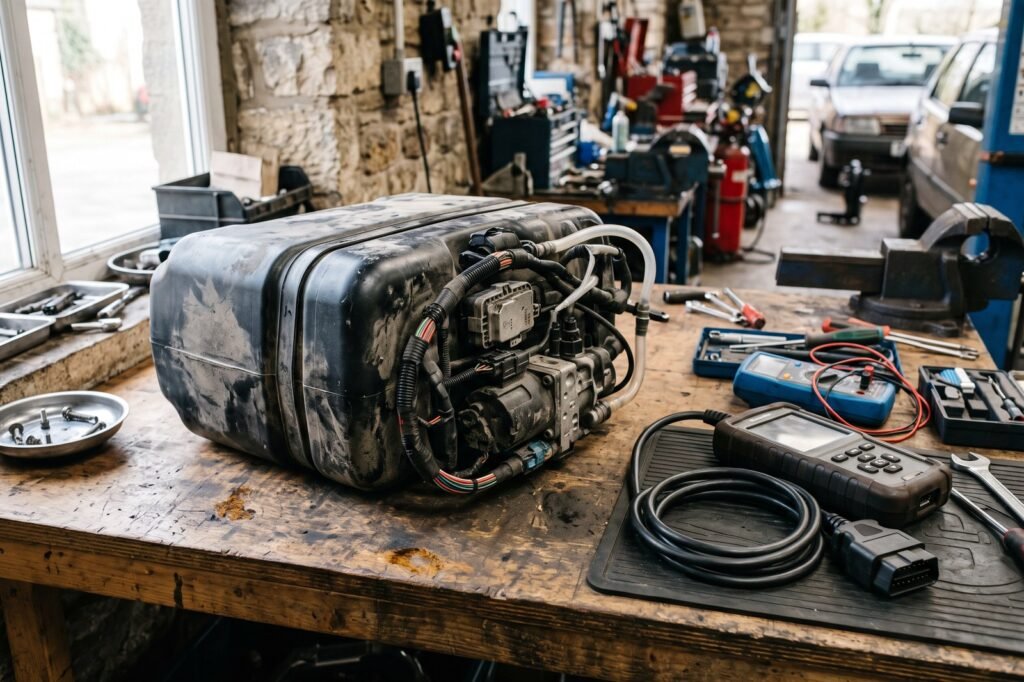
A typical light commercial SCR setup includes a tank with a level and quality sensor, a heater to stop the fluid freezing, a supply line, a pump or dosing module, a metering injector into the exhaust, the SCR catalyst itself, and at least two NOx sensors reading either side of it. Add the control module and the wiring, and there are a dozen things that can end your run.
None of those parts share a failure curve. The catalyst brick is usually the longest-lived item on the list. The electronics exposed to exhaust heat are usually the shortest.
What Actually Fails First, In Our Experience
The table below reflects what we see on the vans and cars we are called out to across Leicestershire and the Midlands. It is our own pattern rather than a manufacturer statistic, so treat it as a guide to where to look first.
| Component | Typical failure mode | How it usually presents |
|---|---|---|
| NOx sensors | Heater element or element drift from thermal cycling | Warning light, efficiency or plausibility codes, no obvious leak |
| Metering injector | Crystallised deposits restricting the nozzle | Dosing or pressure codes, white residue at the injector |
| Dosing pump / module | Seal wear, internal blockage, motor failure | Pressure build faults, audible pump running long |
| Tank heater circuit | Element or relay failure, corroded connector | Cold-weather-only faults that clear in mild conditions |
| Level / quality sensor | Contamination or crystal build-up on the sensing element | Tank reads wrong, quality warnings with good fluid |
| SCR catalyst | Genuine ageing or poisoning after long-term poor dosing | Efficiency-below-threshold faults that survive part replacement |
The pattern that matters is at the bottom of that table. A catalyst rarely dies of old age on its own. It dies because something upstream was dosing badly for a long time and nobody dealt with it, which is why the early NOx sensor symptoms are worth taking seriously rather than clearing and hoping.

Five Things That Shorten the Life of an SCR System
These are in the order we meet them, not in order of how often people blame them.
1. Short journeys and low annual mileage
SCR wants heat. A van doing six-mile school-run-and-back trips never gets the exhaust properly up to temperature, dosing is intermittent, and residues get a chance to settle rather than being burned through. Low-mileage vehicles are over-represented in our callouts, not under-represented.
2. Fluid sitting in the tank for months
AdBlue is a consumable with a shelf life, and a tank that was filled a year ago on a vehicle that barely moves is a different proposition from fresh fluid. Warm storage accelerates it further.
3. Spills, splashes and careless filling
Every spill dries to a hard white crust, and crusts around the filler, the sensor head and the injector are where a lot of “sensor faults” actually start. Our guide to AdBlue crystallisation and how to prevent it goes through the handling side properly.
4. Driving on with a live warning
A lit AdBlue light is the system telling you it has already failed a check. Every additional week of running with poor dosing loads the catalyst further, which is how a sensor job turns into a catalyst job.
5. Winter, salt and connector corrosion
Tank heaters, level sensors and the loom under the vehicle live in the worst environment on the van. Cold-weather-only faults are almost always a heater or a connector rather than the fluid itself.
Two of the five above are handling habits rather than parts. That is genuinely good news, because habits are free to change and dosing modules are not.
The Fluid Check Your Van Is Legally Required to Run
Drivers are often surprised that a vehicle can object to the AdBlue they have just put in. It is not the manufacturer being awkward — it is a design requirement.
The rules covering vehicles that use a reagent state that the vehicle shall include a means of determining that a reagent corresponding to the characteristics declared by the manufacturer is present, and that the driver warning system must activate where the reagent does not meet those minimum requirements.
The same annex sets out the inducement system, which must be designed so the vehicle cannot operate with an empty reagent tank. Manufacturers pick their approach — a no-restart countdown, a no-start after refuelling, a fuel lockout or a speed limit — but the escalation is not optional and it is not a fault in itself.
The practical consequence for system life is simple. Poor or contaminated fluid does not quietly degrade the system in the background for years. It is detected, and it starts the clock. That is a design feature working as intended, however unwelcome it feels on a Friday afternoon.
How to Get the Most Life Out of the System
- Buy fluid you will use within a few months. A 10-litre container you get through is better value than a 20-litre drum that ages in the garage.
- Fill carefully and wipe spills immediately. Water and a cloth, while it is still wet, prevents the crust forming.
- Give the van a decent run periodically. A sustained drive at motorway speed does more for SCR health than any additive.
- Never top up with anything other than AdBlue. Water, screenwash and diesel in the AdBlue tank all end in a strip-down.
- Act on the first warning, not the third. Early faults are usually a sensor. Late ones are usually a catalyst.
- Keep the paperwork. Fluid receipts and service records matter if you ever need to argue the fault was not self-inflicted.
Our View on Repair Versus Replace
Once a system starts failing, the question is rarely “how long was this supposed to last” and almost always “is this one fault or the start of a pattern”.
Our rule of thumb is that a first failure on an otherwise healthy vehicle is a repair, not a write-off. A single NOx sensor, a dosing injector or a heater circuit is a contained job with a clear diagnosis behind it. Where we get more cautious is the third fault in eighteen months on a vehicle that has been running lit for most of them, because by then the catalyst is often the real patient.
That is the point at which the numbers deserve a proper look rather than a guess, and our AdBlue repair cost guide sets out what the individual jobs actually run to. If the fault is still undiagnosed, that comes first — our mobile diagnostics service reads the stored history rather than the current light, and the history is what tells you whether this is one part or a pattern.
Where it is a genuine component failure, that is exactly the work our SCR system repair service is built around, and we come to the vehicle rather than the other way about.
Lifespan is mostly a consequence, not a specification. The vans that reach 150,000 miles with the original dosing system are not lucky — they are the ones that got long runs, fresh fluid and an early diagnosis the first time a light came on.
AdBlue Warning On a High-Mileage Van?
We diagnose SCR faults at your home or yard across Leicester and the Midlands, and we will tell you straight whether it is one part or a pattern.
Frequently Asked Questions
How many miles should an AdBlue system last?
There is no published service life. The nearest thing to a benchmark is the type-approval rule requiring durability testing of pollution control devices to cover 160,000 km, which is around 100,000 miles. Individual parts vary enormously either side of that, with NOx sensors typically the first to go.
Does low mileage make AdBlue problems more likely?
Yes, and it surprises people. SCR systems depend on exhaust heat and regular dosing, so vehicles doing short, cold journeys tend to see deposits and sensor faults sooner than motorway vehicles. Fluid also sits in the tank longer on a low-mileage van.
Can a NOx sensor be replaced without replacing the whole system?
In most cases yes. A single failed sensor on a system that is otherwise dosing correctly is a contained repair. It becomes a bigger conversation when efficiency faults persist after the sensor is changed, which usually points further downstream.
Will poor-quality AdBlue damage the system permanently?
Not usually if it is caught quickly, because the vehicle is required to detect a reagent that does not meet the manufacturer’s declared characteristics and warn the driver. Damage comes from running for a long period on poor fluid, not from a single bad fill that is drained and replaced.
Do you cover my area?
We are based in Leicester and cover Leicestershire and the wider Midlands. Send us your postcode and we will confirm straight away whether we can come to you.
Featured image: photo by cottonbro studio on pexels.