AdBlue Guide • Consumption & Dosing
AdBlue Consumption Fault: Why Your Van Is Using So Much AdBlue
A car should get through about 1.5 litres of AdBlue every 1,000 kilometres. If yours is emptying a five-litre bottle every few weeks, the tank is not the problem — the dosing decision behind it is.
In This Guide
High AdBlue consumption is almost never a fault with the AdBlue itself. It is the engine ECU dosing more urea than it should, because a NOx sensor is reporting badly, or it is fluid escaping before it reaches the catalyst through a leaking dosing injector or a cracked tank. Genuine over-dosing usually arrives with no warning light at all, which is why it gets ignored until the bills add up.
What Normal AdBlue Consumption Looks Like
Before calling something excessive, it helps to know the baseline. The German automotive industry association VDA, which owns the AdBlue trademark and sets the licensing terms, states that a passenger car consumes an average of around 1.5 litres of AdBlue per 1,000 kilometres, and that consumption varies with vehicle weight and driving style.
Translated into the numbers a UK driver actually uses, that is roughly one litre every 400 miles for a car. Vans sit higher because they are heavier and worked harder, and a fully laden 3.5-tonne panel van doing multi-drop work can comfortably double a car’s rate without anything being wrong.
| Vehicle type | Typical use per 1,000 miles | Rough refill interval on a 15-litre tank |
|---|---|---|
| Diesel car, mixed driving | 2–3 litres | 5,000–7,000 miles |
| Small van, light loads | 3–5 litres | 3,000–5,000 miles |
| Large panel van, laden | 5–8 litres | 2,000–3,000 miles |
| Any of the above with a dosing fault | 10–20+ litres | Weeks, not months |
The useful signal is not the absolute number. It is the change. A van that always went 3,000 miles between top-ups and now goes 800 has a fault, even if 800 miles would be perfectly normal for a different vehicle.
Four Reasons It Is Not a Fault
Plenty of consumption complaints turn out to be the system working exactly as designed. It is worth ruling these out before paying anyone to look.
- Cold weather and short journeys. The SCR catalyst has to reach temperature before dosing is efficient. Winter town work means more dosing for the same result.
- Heavy loads and towing. More engine load produces more raw NOx, and more NOx needs more urea to neutralise. A laden van genuinely uses more.
- Stop-start urban duty cycles. Steady motorway running is the most efficient case; delivery rounds are the least.
- A recent software update. Several manufacturers revised SCR dosing strategies after real-driving-emissions rules tightened, and the revised maps often dose harder than the ones they replaced.
None of those should double consumption overnight. If the change was sudden rather than seasonal, move on to the faults below.
Four Faults That Make a Van Drink AdBlue
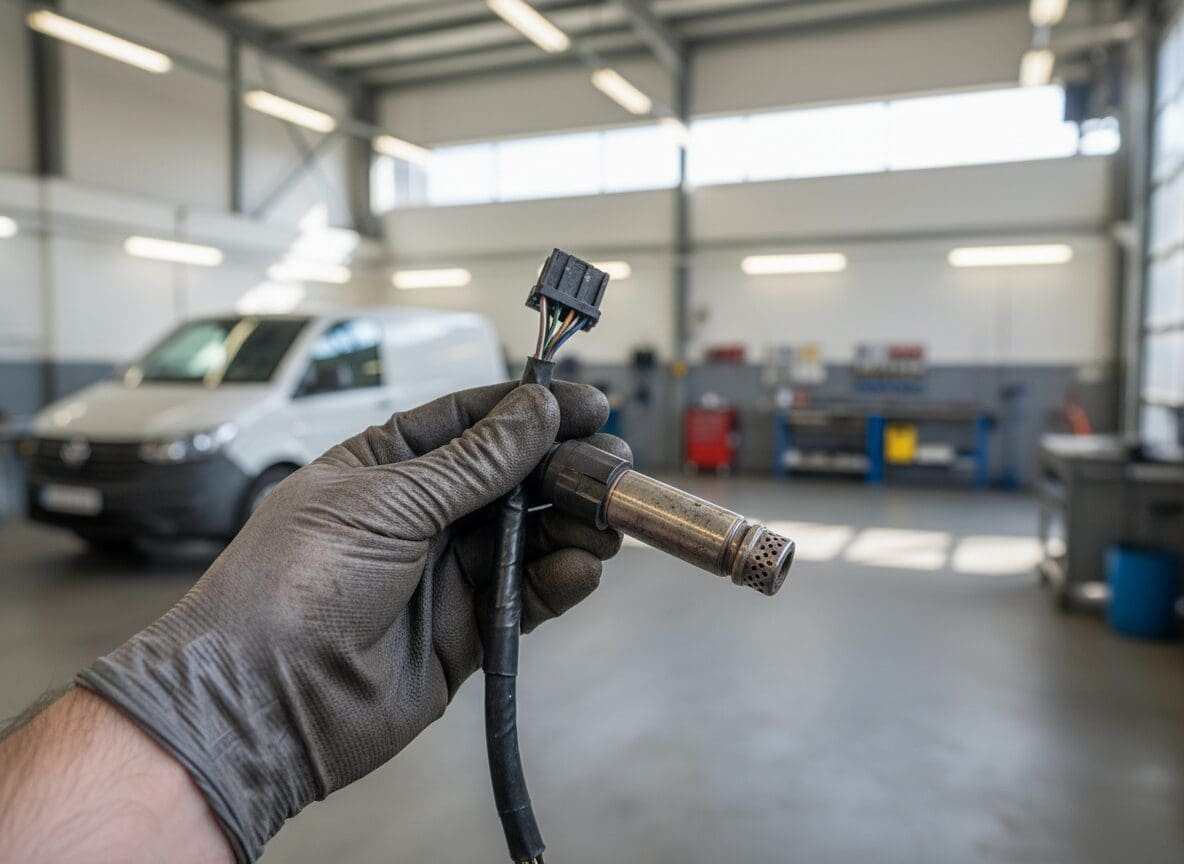
1. A NOx sensor reporting badly, but not badly enough to flag
This is the most common cause we see and the most frustrating, because the sensor is not dead. A NOx sensor that has drifted still returns plausible-looking values, so the ECU trusts them. If it over-reports NOx downstream of the catalyst, the ECU concludes that conversion is poor and doses more urea to compensate.
Consumption rises. Emissions do not improve, because the extra urea was never needed. Often no fault code is stored at all, because nothing has gone out of range — it has simply gone wrong.
2. A leaking or partially blocked dosing injector
The dosing injector meters AdBlue into the exhaust stream in precise pulses. A worn seat can weep between pulses, so fluid leaves the tank without ever being counted as a dose. The ECU then doses the amount it thinks is required on top of what has already leaked.
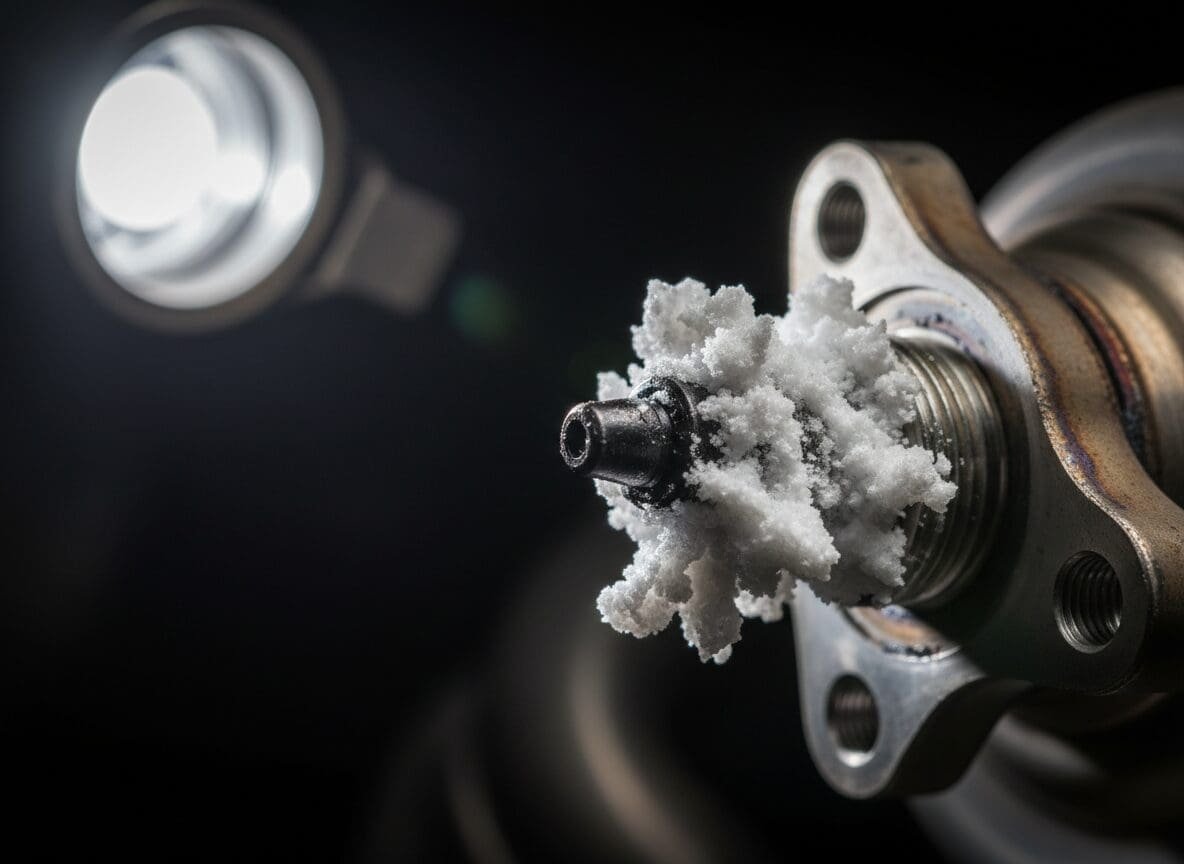
The tell is usually visible rather than electronic: white or pale-yellow crystalline deposits around the injector body or the exhaust boss. We have set out the wider failure pattern in our guide to AdBlue injector failure symptoms and replacement costs.
3. A physical leak from the tank, lines or pump
Less common but far simpler to confirm. AdBlue leaks evaporate and leave a distinctive white residue behind rather than a wet patch, so the evidence survives long after the drip has dried. Look under the tank, along the delivery line and around the pump housing.
Pump-side leaks often arrive alongside pressure faults rather than on their own, and the two get confused constantly. Our breakdown of AdBlue pump failure symptoms covers how the pump behaves when it is genuinely at fault.
4. A level sensor that is reading the tank wrong
Worth naming because it produces the appearance of high consumption without any extra fluid being used. If the level sensor under-reads, the gauge falls faster than the tank empties and the driver tops up more often than necessary. The clue is that the tank takes noticeably less fluid than the gauge suggested it should.
Unexpectedly high AdBlue consumption is one of the five things we ask about when someone calls, alongside warning lights, no-start countdowns and returning fault codes. It is one of the clearest early indicators that the SCR system is making a bad decision rather than suffering a broken part.
Leak or Over-Dosing? How to Tell
The two causes need completely different work, so separating them early saves money. A rough field test costs nothing.
| Observation | Points towards |
|---|---|
| Level drops while the vehicle is parked for days | Physical leak |
| Level drops only in proportion to miles driven | Over-dosing |
| White crystalline residue under the vehicle | Leak, tank or line |
| White residue only at the exhaust dosing point | Injector weeping |
| Consumption worse on motorway runs | Over-dosing, sensor-driven |
| Consumption worse on short urban trips | Often normal, not a fault |
Park the vehicle on clean, dry ground overnight and look underneath in the morning. A leak that only shows when the system is pressurised will not appear, but a tank or line leak usually will.
Why a New NOx Sensor Often Does Not Fix It
This is the part that catches people out, and it is expensive when it does. NOx sensors are not cheap, and fitting one to a van that is over-dosing feels like the obvious move.
The problem is that the ECU holds learned adaptation values built up from the old sensor’s readings. Fit a new sensor and those learned values remain, so the system carries on dosing against a correction it worked out from faulty data. Consumption stays high, the owner concludes the new sensor was faulty too, and a second one goes in.
The adaptation has to be reset and relearned with a tool capable of talking to the SCR system properly. A generic code reader will clear a stored fault but will not touch adaptations. If you want the cost side of the sensor decision first, our guide to NOx sensor replacement costs in the UK sets out what the parts and labour actually run to.
There is a second reason not to reach for parts first. VDA’s guidance notes that running an SCR-equipped vehicle without adequate AdBlue risks damaging the SCR equipment itself, and the ACEA driver guidance is equally clear that the AdBlue tank must not be allowed to run to empty. An owner who is watching a rising bill and starting to stretch the intervals between top-ups is trading a diagnostic problem for a hardware one.
What Diagnosis Actually Involves
Reading stored codes is the least useful part of this job, because over-dosing frequently stores nothing. What matters is live data: upstream and downstream NOx values compared against each other, dosing quantity per unit of time, tank level trend, and the adaptation values the ECU is currently applying.
Those four together will usually separate a drifting sensor from a weeping injector inside half an hour, without removing anything. It is the work our mobile diagnostics service exists to do, and it is why we would rather scan a vehicle than quote for a part over the phone.
If the outcome is a genuine component fault, that is a repair. If the outcome is a system that has learned bad values, it is a software and adaptation job, which is the route we take on most of the AdBlue problems we are called out to.
FAQs
How much AdBlue should my van use?
As a starting point, a diesel car averages around 1.5 litres per 1,000 kilometres, which is roughly a litre every 400 miles. A large laden van will use two to three times that. The number that matters is your own historic average — a sudden change against it means far more than a comparison with someone else’s vehicle.
Can a faulty NOx sensor cause high AdBlue consumption?
Yes, and it is the most common cause. A sensor that has drifted rather than failed outright still returns believable readings, so the ECU keeps trusting them and doses more urea than the engine needs. Because nothing has gone out of range, there is often no warning light and no stored code to point at it.
Why is my AdBlue warning light coming on so often?
If it is the low-level warning, the tank really is emptying faster than it should and you are dealing with consumption. If it is an AdBlue system or emissions malfunction warning, that is a different fault entirely and is not about the amount of fluid. Check whether the message says low or malfunction, because the two lead in opposite directions.
Does an AdBlue leak look the same as high consumption?
On the dashboard, yes — both simply empty the tank. Underneath, no. AdBlue leaks evaporate and leave a white crystalline residue rather than a wet stain, so a leak leaves visible evidence that over-dosing never does. Parking on clean dry ground overnight is the quickest way to separate them.
Will high AdBlue consumption fail an MOT?
Not by itself. The MOT emissions test does not measure AdBlue use, and there is no consumption threshold in the test. What can fail is an emissions-related warning light that stays illuminated, and an over-dosing system that eventually damages the catalyst may produce one. Consumption is a cost and reliability problem before it is an MOT problem.
Van Drinking AdBlue? Get the Live Data Read
Mobile AdBlue and SCR diagnostics across Leicester, Leicestershire and the Midlands. We read dosing quantities, NOx sensor values and stored adaptations at your location, so you find out what the system is actually doing before anyone buys a part.
Related Guides
About This Guide
- Reviewed and signed off by iFix AdBlue— mobile AdBlue and SCR specialists covering Leicester, Leicestershire and the Midlands, with 300+ mobile AdBlue jobs completed since 2020.
Published 1 October 2026 • Last updated 1 October 2026